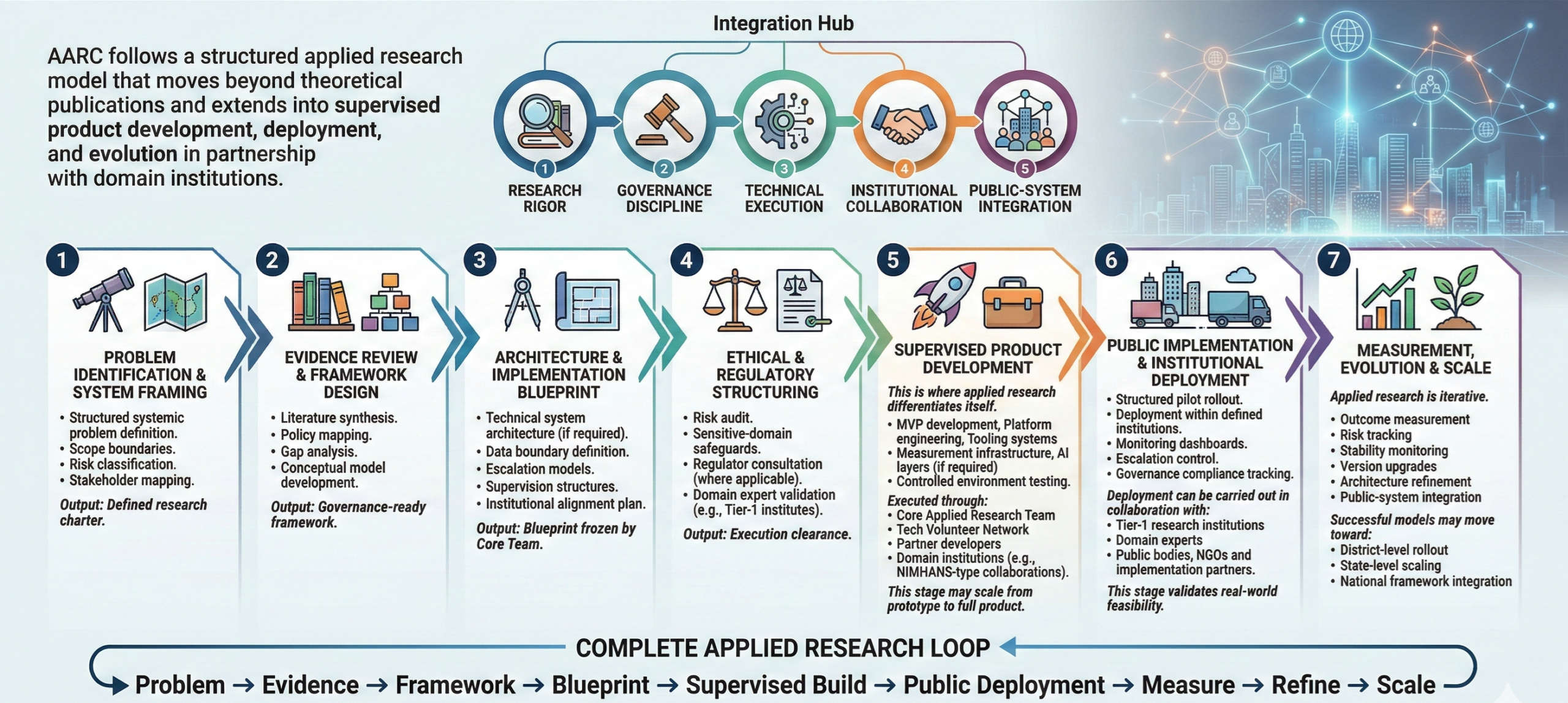
AARC follows a structured applied research model that moves beyond academic study and extends into supervised product development, institutional deployment, and continuous evolution.
This model ensures that every initiative:
- Begins with systemic problem framing
- Is grounded in evidence
- Is ethically structured
- Is implemented under supervision
- Is measured rigorously
- Evolves through structured feedback
The objective is not publication alone — but governance-ready, scalable public systems.
The Complete Applied Research Loop
Problem
→ Evidence
→ Framework
→ Governance
→ Build
→ Deploy
→ Measure
→ Refine
→ Scale
This disciplined cycle ensures that AARC initiatives are:
• Research-grounded
• Ethically structured
• Institutionally compatible
• Technically validated
• Scalable within public systems
Stage 1 - Problem Identification & System Framing
Every initiative begins with clearly defining the problem at a systemic level.
Rather than addressing isolated cases, AARC studies structural gaps that affect populations, institutions, and policy ecosystems.
This phase includes:
• Identifying system-level failure patterns
• Mapping stakeholders and institutional actors
• Defining scope boundaries and exclusions
• Classifying domain sensitivity (general / regulated / critical)
• Clarifying measurable objectives
This prevents scope drift and emotional decision-making.
Output of This Phase
• Formal Research Charter
• Clearly defined system boundaries
• Risk classification summary
• Problem statement approved by Core Applied Research Team
Stage 2 - Evidence Review & Gap Analysis
The Core Applied Research Team conducts:
• National and global literature review
• Policy landscape analysis
• Existing framework evaluation
• Regulatory context mapping
• Data availability assessment
This prevents duplication and ensures alignment with existing systems.
Output of this stage:
• Evidence-backed gap analysis document
• Policy landscape summary
• Identified structural research gaps
• Feasibility and alignment assessment
Stage 3 - Framework & Architecture Development
At this stage, AARC translates research findings into structured models.
This includes:
• Conceptual framework design
• Governance structure definition
• Escalation and supervision pathways
• Measurement and evaluation metrics
• Ethical guardrails
• Technical architecture blueprint (if required)
All architectural decisions are frozen before execution begins.
Output of This Phase
• Governance-ready framework
• Implementation blueprint
• Defined measurement model
• Approved architectural documentation
Phase 4 — Ethical & Institutional Structuring
Before any implementation begins, structured governance review is conducted.
This phase may involve collaboration with:
• Domain experts
• Tier-1 research institutions
• Regulatory bodies (where required)
Focus areas include:
• Ethical risk review
• Data boundary definition
• Role-based access controls
• Escalation authority definition
• Institutional compatibility assessment
No pilot proceeds without governance clearance.
Output of This Phase
• Ethical risk review summary
• Institutional validation notes
• Governance clearance approval
• Documented supervision structure
Phase 5 — Supervised Product Development
Applied research transitions into structured execution.
Development may include:
• MVP design and engineering
• Platform or tooling systems
• AI-assisted models (if applicable)
• Data pipelines and dashboards
• Controlled test environments
Execution is carried out through:
• Core Applied Research Team
• Tech Volunteer Network
• Partner developers
• Institutional collaborators
Architectural deviation is not permitted during this phase.
Output of This Phase
• Functional prototype or MVP
• Documented build architecture
• Test validation reports
• Deployment readiness assessment
Phase 6 — Public Implementation & Institutional Deployment
Validated models may move into structured pilot deployment.
This stage focuses on:
• Controlled rollout within defined institutions
• Monitoring through structured dashboards
• Escalation and supervision enforcement
• Institutional feedback collection
• Compliance verification
Deployment may occur in collaboration with:
• Tier-1 research institutions
• Domain experts
• NGOs or community partners
• Public bodies
This stage tests real-world stability.
Output of This Phase
• Pilot performance report
• Governance compliance verification
• Institutional compatibility assessment
• Deployment stability evaluation
Phase 7 — Measurement, Evolution & Scale
Applied research is iterative.
After deployment:
• Outcomes are measured against predefined metrics
• Risks are monitored
• System refinements are introduced
• Architecture adjustments are documented
• Version upgrades are structured
Successful models may move toward larger institutional integration.
Output of This Phase
• Impact measurement report
• Version update documentation
• Scalability readiness summary
• Institutional scale recommendations