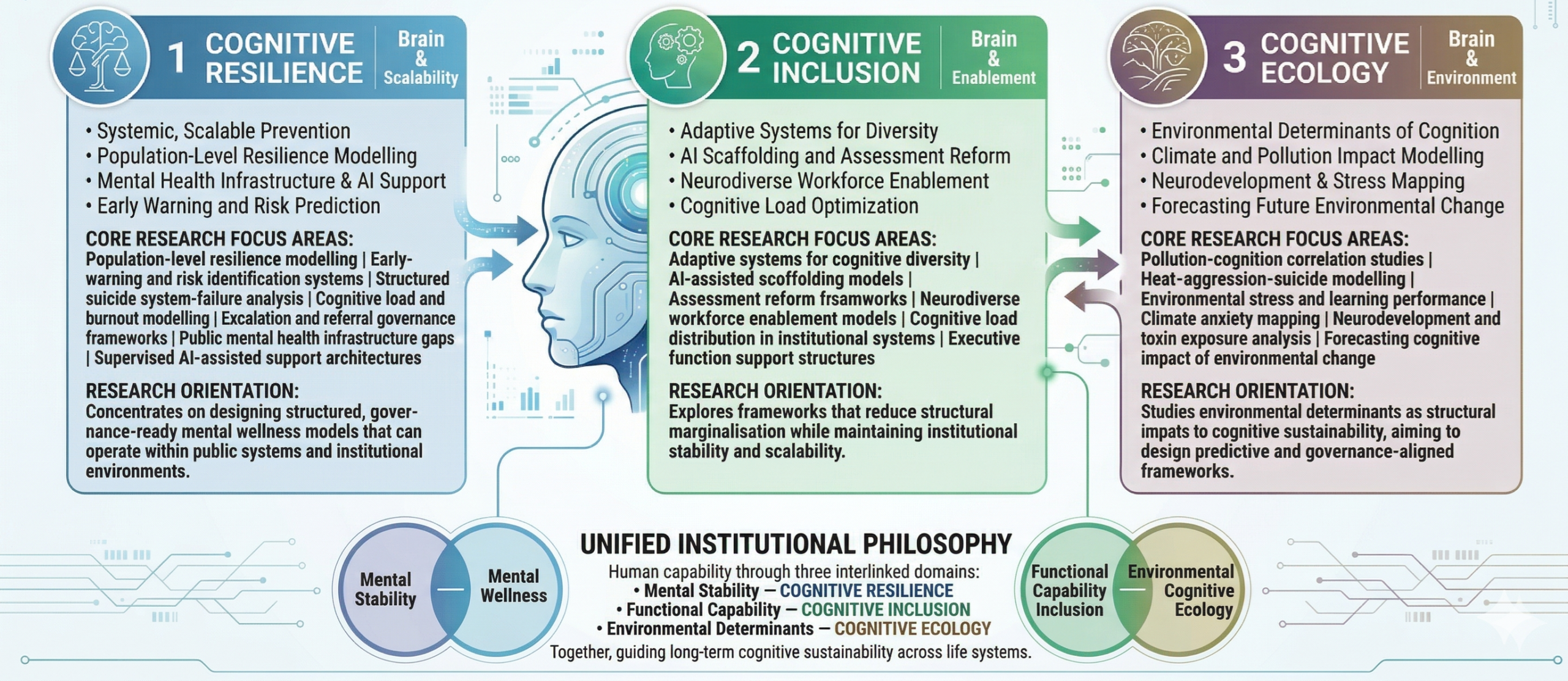
 AARC organises its applied research under three cognition-centric Chapters.
Each Chapter focuses on systemic analysis, preventive frameworks, and governance-ready models designed for long-term societal resilience.
The Chapters are interdependent and reflect AARC’s view that mental stability, functional capability, and environmental determinants together shape human cognitive sustainability.
Unified Institutional Philosophy
AARC views human capability through three interlinked domains:
• Mental Stability — Mental Wellness
• Functional Capability — Cognitive Inclusion
• Environmental Determinants — Cognitive Ecology
Together, these domains guide AARC’s applied research direction toward long-term cognitive sustainability across life systems.
Scope
The Mental Wellness Chapter focuses on preventive, system-level, and scalable mental health research beyond purely clinical intervention.
It studies structural gaps in access, escalation systems, population risk patterns, and institutional readiness.
Core Research Focus Areas
• Population-level resilience modelling
• Early-warning and risk identification systems
• Structured suicide system-failure analysis
• Cognitive load and burnout modelling
• Escalation and referral governance frameworks
• Public mental health infrastructure gaps
• Supervised AI-assisted support architectures
Research Orientation
This Chapter concentrates on designing structured, governance-ready mental wellness models that can operate within public systems and institutional environments.
Scope
The Cognitive Inclusion Chapter studies systemic exclusion created by uniform cognitive expectations across education and work environments.
It focuses on enabling diverse cognitive profiles to function effectively within structured systems.
Core Research Focus Areas
• Adaptive systems for cognitive diversity
• AI-assisted scaffolding models
• Assessment reform frameworks
• Neurodiverse workforce enablement models
• Cognitive load distribution in institutional systems
• Executive function support structures
Research Orientation
The Chapter explores frameworks that reduce structural marginalisation while maintaining institutional stability and scalability.
Scope
The Cognitive Ecology Chapter examines how environmental conditions influence cognitive development, emotional regulation, and long-term mental stability.
It integrates environmental stress research with mental health and functional performance modelling.
Core Research Focus Areas
• Pollution–cognition correlation studies
• Heat–aggression–suicide modelling
• Environmental stress and learning performance
• Climate anxiety mapping
• Neurodevelopment and toxin exposure analysis
• Forecasting cognitive impact of environmental change
Research Orientation
This Chapter studies environmental determinants as structural inputs to cognitive sustainability, aiming to design predictive and governance-aligned frameworks.