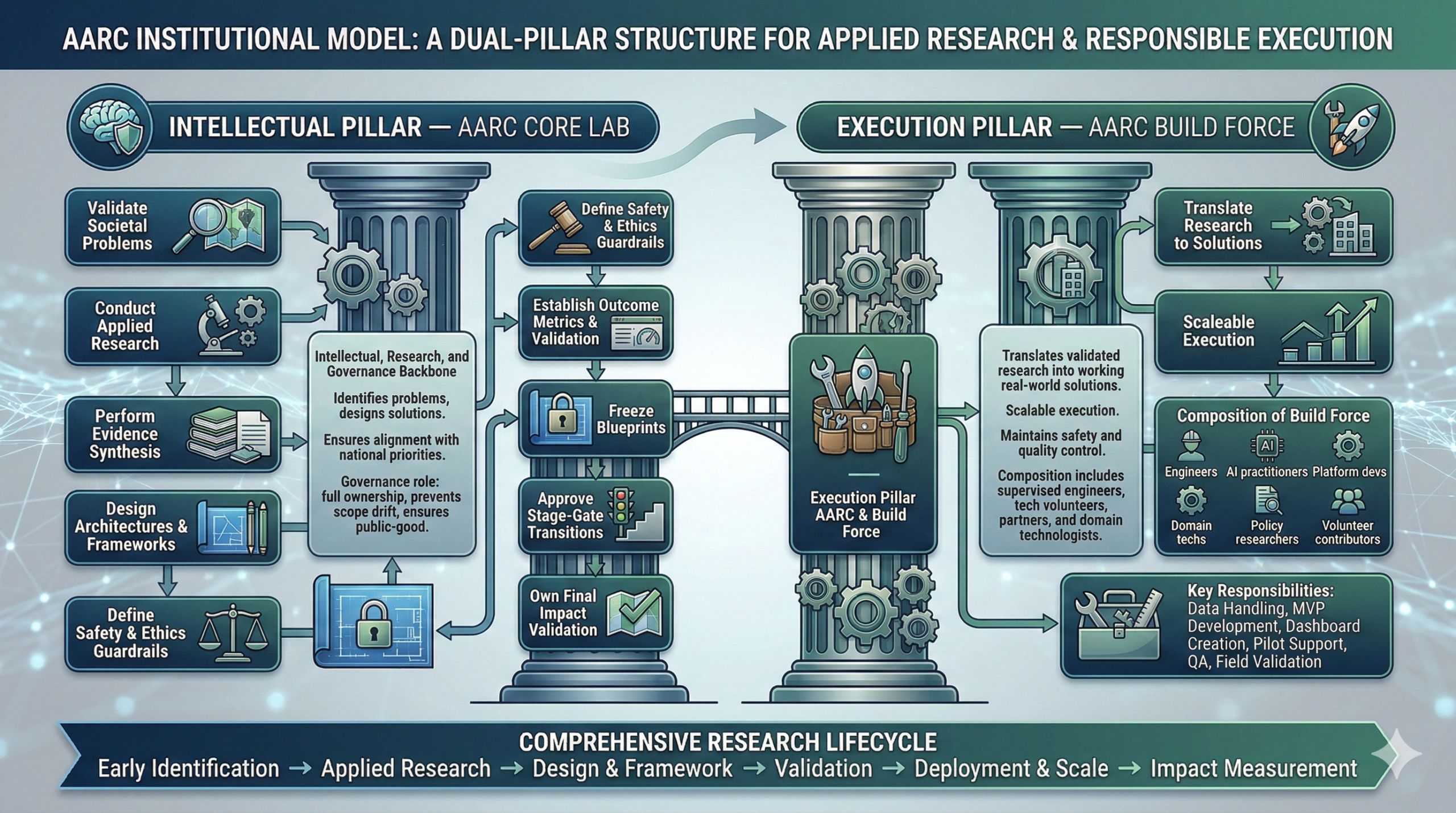
 AARC is structured around a dual-pillar institutional model designed to ensure strong research integrity, disciplined governance, and responsible execution at scale
This structure enables AARC to take real societal challenges from early identification through research, development, validation, and deployment—without compromising ethics, safety, or public interest.
Intellectual Pillar — AARC Core Lab
The AARC Core Lab forms the intellectual, research, and governance backbone of AARC.
This pillar is responsible for identifying real societal problems, conducting applied research, and designing solution frameworks that are practical, ethical, and scalable. It ensures that every initiative is grounded in evidence and aligned with national priorities.
Key Responsibilities
- Validate societal problems for relevance, urgency, and scalability
- Conduct applied research across technical, policy, and community dimensions
- Perform literature reviews and evidence synthesis (national & global)
- Design system architectures, solution frameworks, and MVP definitions
- Define safety, ethics, regulatory, and compliance guardrails
- Establish measurable outcome metrics and validation criteria
- Freeze blueprints before execution begins
- Approve stage-gate transitions across lifecycle phases
- Own final impact validation and accountability
Governance Role – The Core Lab:
- Retains full ownership of research direction and architectural decisions
- Prevents scope drift and uncontrolled expansion
- Ensures alignment with public-good principles
- Maintains documentation, transparency, and audit readiness
This pillar ensures that innovation at AARC is disciplined, research-grounded, policy-aligned, and ethically structured
Execution Pillar — AARC Build Force
The AARC Build Force translates validated research into working, real-world solutions.
This pillar consists of supervised engineers, trained tech volunteers, partner developers, and domain technologists who execute within clearly defined architectural and governance boundaries
It enables scalable execution while maintaining safety and quality control.
Composition
- Engineering graduates
- AI and data practitioners
- Backend and platform developers
- Domain technologists
- Policy researchers
- Corporate volunteer contributors
Key Responsibilities
- Data collection, preprocessing, and structured handling
- Prototype and MVP development
- Tooling and dashboard creation (where required)
- Pilot implementation support
- Quality assurance and stabilisation
- Impact measurement automation
- Field-level validation support
Strict Execution Boundaries
To protect quality and public trust:
- The Build Force does not redefine architecture
- No scope changes without Core Lab approval
- No unsupervised work in sensitive domains
- No direct access to regulated or classified data
- All execution follows frozen blueprints